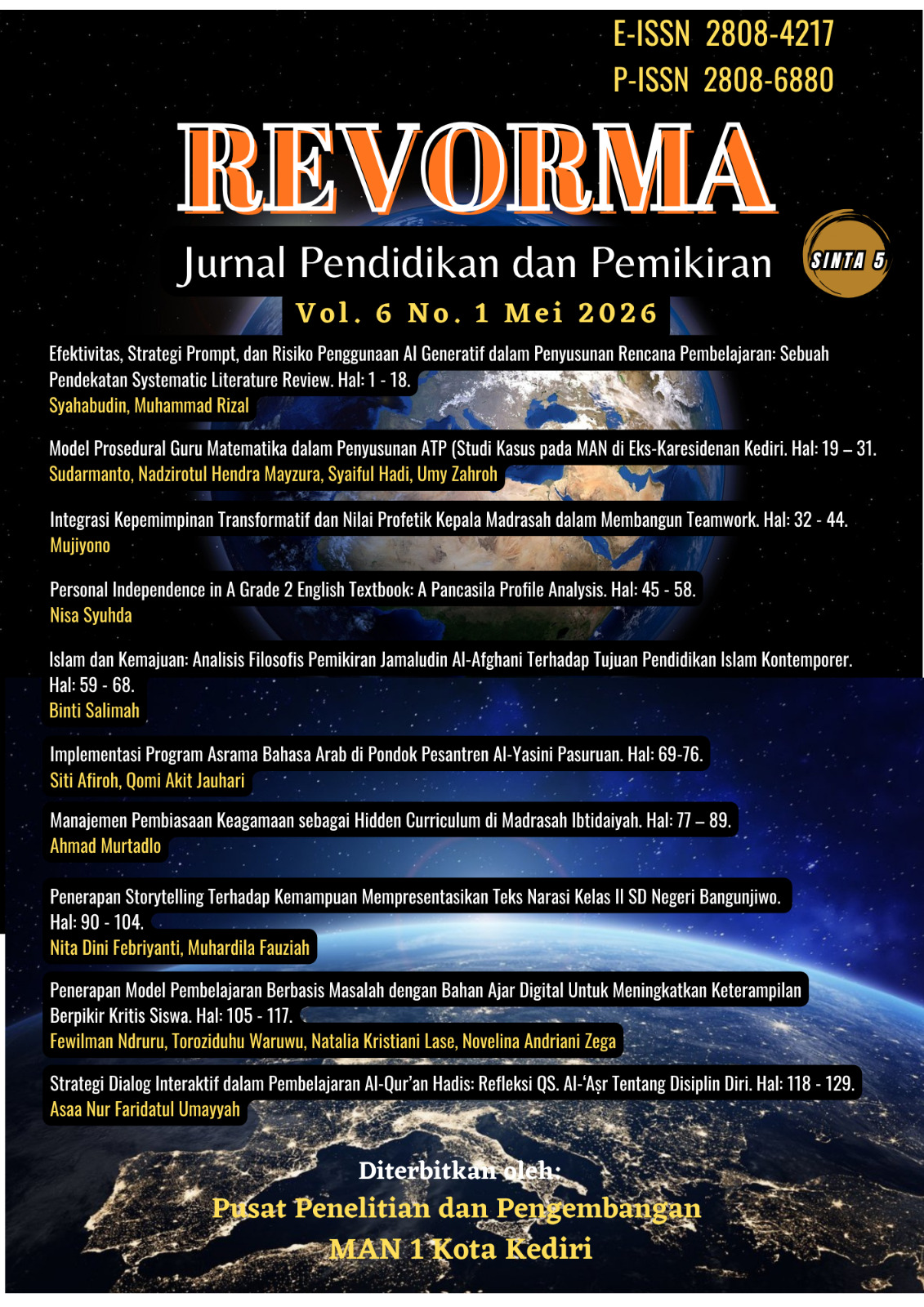
Efektivitas, Strategi Prompt , dan Risiko Penggunaan AI Generatif dalam Penyusunan Rencana Pembelajaran: Sebuah Pendekatan Systematic Literature Review
DOI:
https://doi.org/10.62825/revorma.v6i1.195Keywords:
AI generatif, rencana pembelajaran, prompt engineering , lesson planning, systematic literature reviewAbstract
Penelitian ini mensintesis bukti tentang efektivitas, strategi prompt, dan risiko penggunaan AI generatif dalam penyusunan rencana pembelajaran. Review sistematis ini mengikuti PRISMA 2020 atas artikel jurnal Scopus dan SINTA periode 2023 - April 2026. Seleksi menghasilkan 16 studi yang dianalisis melalui sintesis tematik kualitatif dan appraisal kualitas berbasis MMAT serta pembacaan deskriptif untuk artikel konseptual. Hasil menunjukkan bahwa AI generatif paling konsisten meningkatkan efisiensi waktu, membantu struktur awal lesson plan, melengkapi komponen dasar, dan memudahkan revisi. Strategi prompt yang paling produktif ialah prompt kontekstual, berbasis peran atau rubrik, iteratif, dan berbasis contoh. Risiko yang paling menonjol ialah ketidaksesuaian pedagogik, diikuti halusinasi informasi, bias, serta isu etika. Temuan menegaskan bahwa AI generatif paling bernilai ketika ditempatkan sebagai mitra drafting yang tetap dikendalikan oleh penilaian profesional guru.
Downloads
References
Al-khresheh, M. H. (2024). Bridging technology and pedagogy from a global lens: Teachers’ perspectives on integrating ChatGPT in English language teaching. Computers and Education: Artificial Intelligence, 6, 100218. https://doi.org/10.1016/j.caeai.2024.100218
Hashem, R., Ali, N., El Zein, F., Fidalgo, P., & Khurma, O. A. (2024). AI to the rescue: Exploring the potential of ChatGPT as a teacher ally for workload relief and burnout prevention. Research and Practice in Technology Enhanced Learning, 19, 1–29. https://doi.org/10.58459/rptel.2024.19016
Tran, P. T. H. (2025). Preparing preservice teachers for generative AI in lesson planning: Comparing AI mindset and tools-only training approaches. Journal of Technology and Teacher Education, 33(1), 45–71. https://doi.org/10.1080/21532974.2025.2583516
Baytak, A. (2024). The content analysis of the lesson plans created by ChatGPT and Google Gemini. Research in Social Sciences and Technology, 9(1), 329–350. https://doi.org/10.46303/ressat.2024.19
Biberman-Shalev, L. (2025). Prompt ing theory into practice: Utilizing ChatGPT-4 in a curriculum planning course. Education Sciences, 15(2), 196. https://doi.org/10.3390/educsci15020196
Dornburg, A., & Davin, K. J. (2025). ChatGPT in foreign language lesson plan creation: Trends, variability, and historical biases. ReCALL, 37(3), 332–347. https://doi.org/10.1017/S0958344024000272
ElSayary, A. (2024). An investigation of teachers’ perceptions of using ChatGPT as a supporting tool for teaching and learning in the digital era. Journal of Computer Assisted Learning, 40(3), 931–945. https://doi.org/10.1111/jcal.12926
ElSayary, A., Kuhail, M. A., & Hojeij, Z. (2025). Examining the role of prompt engineering in utilizing generative AI tools for lesson planning: Insights from teachers’ experiences and perceptions. Human Behavior and Emerging Technologies, 2025(1), 9986139. https://doi.org/10.1155/hbe2/9986139
Gurl, T. J., Markinson, M. P., & Artzt, A. F. (2025). Using ChatGPT as a lesson planning assistant with preservice secondary mathematics teachers. Digital Experiences in Mathematics Education, 11(1), 114–139. https://doi.org/10.1007/s40751-024-00162-9
Hashem, R., Ali, N., El Zein, F., Fidalgo, P., & Abu Khurma, O. (2024). AI to the rescue: Exploring the potential of ChatGPT as a teacher ally for workload relief and burnout prevention. Research and Practice in Technology Enhanced Learning, 19, 23. https://doi.org/10.58459/rptel.2024.19023
Hong, Q. N., Fàbregues, S., Bartlett, G., Boardman, F., Cargo, M., Dagenais, P., ... Pluye, P. (2018). The Mixed Methods Appraisal Tool (MMAT) version 2018 for information professionals and researchers. Education for Information, 34(4), 285–291. https://doi.org/10.3233/EFI-180221
Istiarsyah, I., Maisura, M., Nurhabibah, N., Kumita, K., & Kamarullah, K. (2024). Transforming teacher competence through ChatGPT: Designing innovative and effective lesson modules. Ideguru: Jurnal Karya Ilmiah Guru, 10(1), 505–513. https://doi.org/10.51169/ideguru.v10i1.1586
Kalenda, P. J., Rath, L., Abugasea Heidt, M., & Wright, A. (2025). Pre-service teacher perceptions of ChatGPT for lesson plan generation. Journal of Educational Technology Systems, 53(3), 219–241. https://doi.org/10.1177/00472395241301388
Karaman, M. R., & Göksu, İ. (2024). Are lesson plans created by ChatGPT more effective? An experimental study. International Journal of Technology in Education, 7(1), 107–127. https://doi.org/10.46328/ijte.607
Luo, Z., & Tahir, R. (2025). ChatGPT-assisted lesson planning for children’s STEAM arts education: An experimental study on benefits, challenges, methods, and a prompt framework. International Journal of Artificial Intelligence in Education, 35, 3696–3745. https://doi.org/10.1007/s40593-025-00513-6
Mishra, P., & Koehler, M. J. (2006). Technological pedagogical content knowledge: A framework for teacher knowledge. Teachers College Record, 108(6), 1017–1054. https://doi.org/10.1111/j.1467-9620.2006.00684.x
Moundridou, M., Matzakos, N., & Doukakis, S. (2024). Generative AI tools as educators’ assistants: Designing and implementing inquiry-based lesson plans. Computers and Education: Artificial Intelligence, 7, 100277. https://doi.org/10.1016/j.caeai.2024.100277
Page, M. J., McKenzie, J. E., Bossuyt, P. M., Boutron, I., Hoffmann, T. C., Mulrow, C. D., ... Moher, D. (2021). The PRISMA 2020 statement: An updated guideline for reporting systematic reviews. BMJ, 372, n71. https://doi.org/10.1136/bmj.n71
Peikos, G., & Stavrou, D. (2025). ChatGPT for science lesson planning: An exploratory study based on pedagogical content knowledge. Education Sciences, 15(3), 338. https://doi.org/10.3390/educsci15030338
Siregar, A. M., Kurniawan, A., Uyun, M. H., & Gea, D. P. (2025). Penggunaan ChatGPT untuk menyusun perangkat pembelajaran tingkat SMA. Jurnal Bhakti Karya dan Inovatif, 5(2), 156–164. https://doi.org/10.37278/bhaktikaryadaninovatif.v5i2.1326
Sukmadana, S. R., & Halim, A. (2026). Perceptions of pre-service English teachers on using ChatGPT for lesson planning. RIGGS: Journal of Artificial Intelligence and Digital Business, 5(1), 2716–2725. https://doi.org/10.31004/riggs.v5i1.5812
Sweller, J. (1988). Cognitive load during problem solving: Effects on learning. Cognitive Science, 12(2), 257–285. https://doi.org/10.1111/j.1551-6708.1988.tb00823.x
Şimşek, N. (2025). Integration of ChatGPT in mathematical story-focused 5E lesson planning: Teachers and pre-service teachers’ interactions with ChatGPT. Education and Information Technologies, 30(8), 11391–11462. https://doi.org/10.1007/s10639-024-13258-x
van den Berg, G., & du Plessis, E. (2023). ChatGPT and generative AI: Possibilities for its contribution to lesson planning, critical thinking and openness in teacher education. Education Sciences, 13(10), 998. https://doi.org/10.3390/educsci13100998
Vygotsky, L. S. (1978). Mind in society: The development of higher psychological processes (M. Cole, V. John-Steiner, S. Scribner, & E. Souberman, Eds.). Cambridge, MA: Harvard University Press.
Downloads
Published
How to Cite
Issue
Section
License
Copyright (c) 2026 Syahabudin Syahabudin, Muhammad Rizal

This work is licensed under a Creative Commons Attribution 4.0 International License.