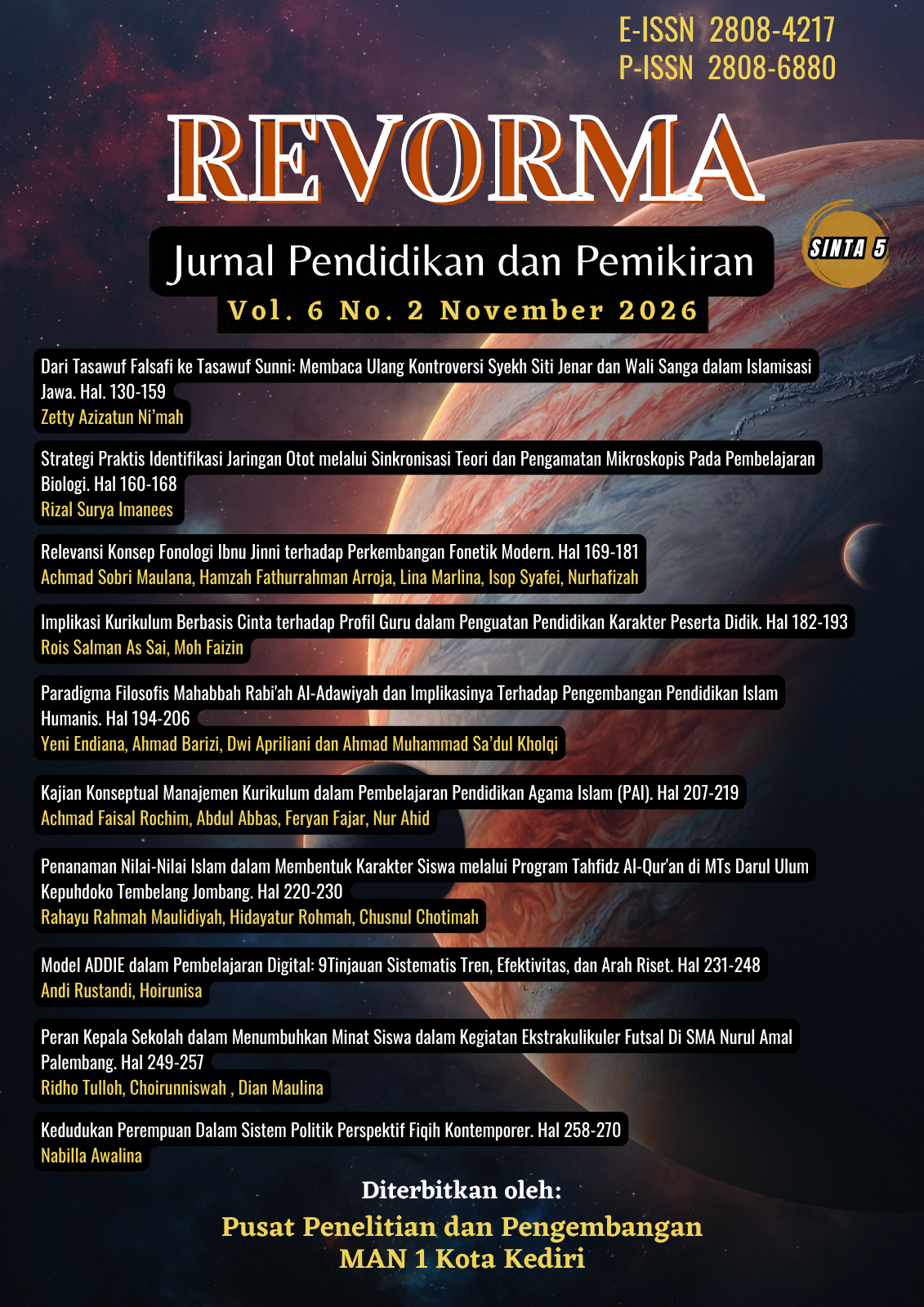
Dari Tasawuf Falsafi ke Tasawuf Sunni: Membaca Ulang Kontroversi Syekh Siti Jenar dan Wali Sanga dalam Islamisasi Jawa
DOI:
https://doi.org/10.62825/revorma.v6i2.233Keywords:
Tasawuf falsafi, tasawuf sunni, Syekh Siti Jenar, Wali Sanga, Islamisasi JawaAbstract
The controversy between Shaykh Siti Jenar and the Wali Sanga is one of the significant discourses in the history of the Islamization of Java, often understood as a conflict between philosophical Sufism and Sunni Sufism. This understanding has frequently given rise to a dichotomy in which Siti Jenar is portrayed as a representative of metaphysical mysticism, while the Wali Sanga are positioned as representatives of Islamic orthodoxy. This article aims to re-examine the controversy by analyzing the development of Sufism, the teachings attributed to Siti Jenar, and the preaching strategies and spirituality of the Wali Sanga in the process of Islamization in Java. This study employs a library research method using historical and historiographical approaches. Data were collected from various relevant primary and secondary sources, including books, journal articles, and research findings, and were subsequently analyzed using content analysis and comparative analysis techniques.
The findings indicate that the differences between the Sufism attributed to Siti Jenar and the Sufism developed within the Wali Sanga tradition are not merely concerned with questions of religious right and wrong. Rather, they reflect different epistemological orientations in understanding the relationship between human beings, God, Islamic law (sharia), and spiritual experience. The Wali Sanga developed a form of Sufism that situated mystical experience within the framework of Islamic creed (aqidah), sharia, and social life, whereas the teachings attributed to Siti Jenar placed greater emphasis on metaphysical reflection concerning human nature and divinity through the concept of manunggaling kawula-Gusti (the union of the servant and God). This study also finds that the sources concerning Siti Jenar are diverse and historiographically problematic; therefore, various narratives about the conflict between Siti Jenar and the Wali Sanga need to be examined critically. Accordingly, the Islamization of Java is more appropriately understood as a dialectical process involving negotiations among Islamic spirituality, local culture, religious authority, and the construction of Islamic knowledge, rather than as the triumph of one form of Sufism over another.
Downloads
References
Ahmad, Rosmani. “Mengenal Azyumardi Azra Dalam Pemikiran Islam.” Journal Analytica Islamica 2, no. 2 (2013): 352–70.
Anshori, Muhammad Afif. “Kontestasi Tasawuf Sunni dan Tasawuf Falsafi di Nusantara.” Teosofi: Jurnal Tasawuf dan Pemikiran Islam 4, no. 2 (2014): 309–27.
Azra, Azyumardi. Jaringan Ulama Timur Tengah. Prenada Media, 2013. https://www.google.com/books?hl=id&lr=&id=E5sCEAAAQBAJ&oi=fnd&pg=PP1&dq=Azyumardi+Azra,+&ots=PWI-1MiQYo&sig=VvmQYl9tgj2TdchKWUVlWfv2n0g.
Cahyani, Kris Nur. “Syekh Siti Jenar Dan Liyan: Ajaran Manunggaling Kawula Gusti Syekh Siti Jenar Dan Relevansinya Bagi Dialog Antar Umat Beragama Di Indonesia.” PhD Thesis, Universitas Kristen Duta Wacana, 2020. https://repository.ukdw.ac.id/id/eprint/4075.
Derani, Saidun. “Syekh Siti Jenar: Pemikiran dan Ajarannya.” Buletin Al-Turas 20, no. 2 (2014): 325–48.
Fauzan, Aris. “‘Ingsun’ Misteri Tasawuf Mistik Syekh Siti Jenar.” Afkaruna: Indonesian Interdisciplinary Journal of Islamic Studies 8, no. 2 (2012): 119–34.
Ginting, Lusinta Rehna, dan Mely Nadia. “Pembentukan dan Perkembangan Tasawuf Falsafi.” Jurnal Bilqolam Pendidikan Islam 2, no. 1 (2021): 50–64.
Goncing, Muh Abdi. “Konsep Ketuhanan Syekh Siti Jenar.” Jurnal Aqidah-Ta, 2020. https://www.academia.edu/download/75733010/Konsep_Ketuhanan_Syekh_Siti_Jenar.pdf.
Kasman, Kasman. “Peran Walisongo dalam mentransfer tasawuf.” El-Furqania: Jurnal Ushuluddin Dan Ilmu-Ilmu Keislaman 4, no. 01 (2018). https://el-furqania.stai-almujtama.ac.id/index.php/elfurqania/article/view/3126.
Muhajirin, Muhajirin, Indo Santalia, dan Andi Ahmad Zahri Nafis. “Mistisisme Islam Wali Songo.” Farabi 22, no. 1 (2025): 47–60.
Ni’am, Syamsun. “Hamzah Fansuri: Pelopor Tasawuf Wujudiyah Dan Pengaruhnya Hingga Kini Di Nusantara.” Epistemé: Jurnal Pengembangan Ilmu Keislaman 12, no. 1 (2017): 261–86.
Ni’mah, Zetty Azizatun, Mukhlis Fahruddin, Jamal Jamal, dan Nada Oktavia. “Dinamika sejarah peradaban Islam.” Pustaka Peradaban, 2023. http://repository.uin-malang.ac.id/28599/.
Pamungkas, Jati. “Syekh Siti Jenar dan Pedukuhan Lemahabang: rekonstruksi sosial makna manunggaling kawulo gusti.” IAIN Kediri Press, 2022. https://repository.iainkediri.ac.id/987/2/Manunggaling%20kawulo%20gusti%20-%20ctk.pdf.
Raya, Jagat. Konsep Jagat Raya Dalam Perspektif Syekh Siti Jenar. T.T. Diakses 7 Agustus 2025. http://download.garuda.kemdikbud.go.id/article.php?article=3356751&val=29426&title=Konsep%20pluralisme%20agama%20dalam%20perspektif%20djohan%20effendi.
Sasmanda, Sifa. “Sejarah Perkembangan dan Pemikiran Tasawuf di Aceh Pada Abad Ke-16 M.” Kalpataru: Jurnal Sejarah dan Pembelajaran Sejarah 2, no. 2 (2016): 67–77.
Shihab, Alwi. Islam sufistik:" Islam pertama" dan pengaruhnya hingga kini di Indonesia. Mizan, 2001.
Shihab, Alwi. Islam sufistik:" Islam pertama" dan pengaruhnya hingga kini di Indonesia. Mizan, 2001.
Sunyoto, Agus. “Atlas Wali Songo: buku pertama yang mengungkap Wali Songo sebagai fakta sejarah,” 2012, https://cir.nii.ac.jp/crid/1971430859843676965.
Sidqi, Ahmad. “Mendaras Manunggaling Kawula Gusti Syekh Siti Jenar.” Dinamika Penelitian: Media Komunikasi Penelitian Sosial Keagamaan 17, no. 1 (2017): 1–26.
Sihombing, Fahrurrozi, dan Nurul Jumadissaniyah Sitorus. “Ajaran Tarekat Syekh Siti Jenar.” Jurnal Ekshis 1, no. 1 (2023): 1–11.
Sofiudin, Muh. “Studi Tasawuf Abd Al-Rahman Al-Sulamī (W. 412 H/1021m)(Perspektif Historis).” PhD Thesis, UIN SUNAN KALIJAGA, 2018. https://digilib.uin-suka.ac.id/id/eprint/32132/.
Sulaeman, Mubaidi. “Pemikiran Tasawuf Falsafi Awal: Rabi’Ah Al-‘Adawiyyah, Al-Bustamī, Dan Al-Hallaj.” Refleksi Jurnal Filsafat Dan Pemikiran Islam 20, no. 1 (2020): 1–24.
Sultoni, Sultoni. “Nilai-nilai ajaran tasawuf Walisongo, dan perkembangannya di Nusantara.” KABILAH: Journal of Social Community 1, no. 2 (2016): 357–78.
Sunyoto, Agus. “Atlas Wali Songo: buku pertama yang mengungkap Wali Songo sebagai fakta sejarah.” (No Title), 2012. https://cir.nii.ac.jp/crid/1971430859843676965.
Simuh. Mistik Islam Kejawen Raden Ngabehi Ranggawarsita. Jakarta: Universitas Indonesia Press, 1998.
Yatim, Badri. 1993. Sejarah Peradaban Islam Dirasah Islamiyah II. Jakarta: PT RajaGrafindo Persada.
Ni’am, Syamsun. “Hamzah Fansuri: Pelopor Tasawuf Wujudiyah Dan Pengaruhnya Hingga Kini Di Nusantara,” Epistemé: Jurnal Pengembangan Ilmu Keislaman 12, no. 1, 2017.
Downloads
Published
How to Cite
Issue
Section
License
Copyright (c) 2026 Ni'mah Zetty Azizatun , Ahmad Rifa’i

This work is licensed under a Creative Commons Attribution 4.0 International License.